Integrating Smiths Detection and CEIA for Throughput and Safety
Author: Shaun Ripani, Vice President, Point Security, Inc.
A Point Security white paper on courthouse checkpoint design
Executive Summary
Courthouses need airport-level weapons detection without airport-scale staffing or floor space. The most reliable way to achieve that is to build the checkpoint from the same detection platforms used at TSA airport checkpoints, configured for a public building rather than a terminal.
Point Security, a certified small business with roughly three decades in security screening sales and service, designs courthouse checkpoints around two of aviation security’s leading manufacturers: Smiths Detection and CEIA. A complete checkpoint uses three layers working together — AI-assisted X-ray for bags and belongings, high-throughput walk-through metal detection for people, and handheld detectors for fast secondary screening.
The specific, current-generation equipment includes the Smiths Detection SDX 6040 (single-view) and HI-SCAN 6040 DV (dual-view) X-ray systems with AI-assisted threat detection; the CEIA SMD600 Plus-MI2 and PMD2 Plus walk-through metal detectors, with the SMD600 Plus-MI2 adding cell phone and smartphone detection; and the CEIA PD140 and PD240 handheld detectors for secondary screening. Together these layers let a courthouse detect weapons and prohibited devices before they enter the building while keeping lines moving and court schedules on time.
How are courthouse and airport security checkpoints alike?
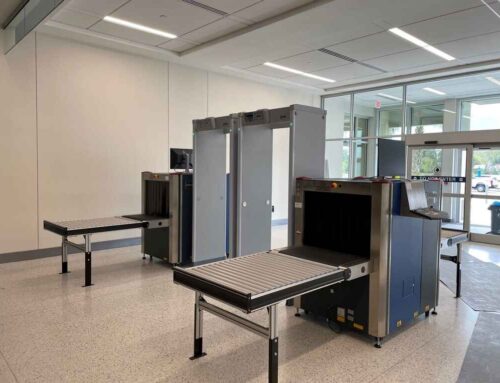
Courthouses and airports share the same core screening problem: large volumes of people moving through a limited number of entrances, with a zero-tolerance standard for weapons reaching secure areas. Courthouses add their own pressures — emotionally charged proceedings and a constant mix of visitors, attorneys, staff, and law enforcement using the same doors.
The difference is scale. A courthouse must reach airport-level detection performance on a smaller footprint, with fewer screeners and a tighter budget. That is why borrowing aviation’s proven equipment — rather than improvising with lower-grade hardware — is the most dependable path to a checkpoint that is both safe and fast.
What screening technology do modern airports use?
Modern airport checkpoints increasingly rely on two technologies. The first is computed tomography (CT) X-ray, which produces detailed 3D images of the contents of bags and allows operators to rotate and inspect items on screen. The second is the millimeter-wave body scanner, used for screening people without physical contact.
These systems represent the leading edge of aviation security and set the benchmark for detection performance. Point Security integrates the manufacturers behind this technology — Smiths Detection and CEIA — into courthouse checkpoints, right-sized for a government building’s space, staffing, and visitor flow.
What does a layered courthouse security checkpoint include?
A well-designed courthouse checkpoint screens both people and their belongings through three complementary layers:
X-ray baggage inspection for bags, purses, briefcases, and parcels.
Walk-through metal detection as the primary people-screening pass.
Handheld metal detection for targeted secondary screening when the walk-through gate alarms.
|
Screening layer |
Equipment |
Purpose |
|
Baggage and parcel X-ray |
Smiths Detection SDX 6040 (single-view) or HI-SCAN 6040 DV (dual-view) |
AI-assisted inspection of bags and belongings |
|
Walk-through metal detection |
CEIA SMD600 Plus-MI2 or PMD2 Plus |
High-throughput primary people screening |
|
Handheld secondary screening |
CEIA PD140 or PD240 |
Pinpoint resolution of walk-through alarms |
This structure supports rapid primary screening, consistent bag inspection, and confident alarm resolution — without defaulting to slow manual searches.
Which X-ray scanners are best for courthouse baggage screening?
For courthouse baggage and parcel screening, Point Security deploys the Smiths Detection SDX 6040 and the HI-SCAN 6040 DV. Both can run AI-assisted image interpretation for automatic threat detection, and Point Security integrates leading AI detection platforms — matching the right one to each facility’s requirements.
Smiths Detection SDX 6040 (single-view). The SDX 6040 is a compact, mobile X-ray system built for high-traffic public buildings. A 160 kV generator delivers high-quality images, and a redesigned detection system eliminates blind spots for a complete view of every item. Smart display tools — organic stripping, enhancement modes, and optimized background contrast — help operators separate organic from inorganic materials and stay vigilant over long shifts. AI-assisted detection can automatically flag a wide range of prohibited items, including pistols, knives, and grenades. [1][2]
Smiths Detection HI-SCAN 6040 DV (dual-view). When a courthouse needs to read densely packed or complex bags from more than one angle, the HI-SCAN 6040 DV captures contents from two perspectives, so operators rarely have to ask a visitor to repack and rescan. It combines proven explosive-detection algorithms with optional AI-assisted weapons detection for pistols, revolvers, gun parts, and flick and fixed-blade knives, and supports centralized screening and health monitoring through the Checkpoint.Evoplus platform. [3]
How to choose between them. AI-assisted interpretation means operator fatigue is no longer the last line of defense. The single-view SDX 6040 favors mobility and a slim footprint; the dual-view 6040 DV favors maximum image clarity and multi-angle confidence. Point Security helps each facility match the configuration to its space, volume, and threat profile.
Which walk-through metal detectors work best for courthouses?
Point Security deploys two CEIA walk-through metal detectors for courthouses, depending on the facility’s needs: the SMD600 Plus-MI2 and the PMD2 Plus.
CEIA SMD600 Plus-MI2. This multi-sensor gate combines two technologies in one frame. The first is the CEIA SMD600 Plus — a 288-channel walk-through metal detector, fully compliant with NIJ 0601.02, that detects magnetic and non-magnetic metal weapons with strong discrimination of harmless personal items. The second is CEIA’s MSD EVO magnetostatic 18-axis sensor, which adds cell phone and smartphone detection, including miniaturized, low-metal-content devices. The gate signals weapons and electronic devices with distinct optical and acoustic alerts — typically red for weapons and yellow for phones — so operators resolve each alarm quickly while keeping throughput high and the nuisance-alarm rate low. [4][5]
CEIA PMD2 Plus. For checkpoints that prioritize maximum throughput and pinpoint accuracy, the PMD2 Plus offers superior detection with high discrimination of non-threat items. It localizes alarms across 60 pinpoint zones (20 vertical by 3 lateral) and uses CEIA’s Met-Identity technology to indicate a threat’s position, intensity, and likely composition. With up to 50 built-in security programs — international standards plus customizable levels — and compliance with worldwide airport security standards, it adapts to a courthouse’s specific policy while keeping lines moving. [6][7]
How do courthouses detect cell phones at the security checkpoint?
The most efficient way to detect cell phones at a courthouse checkpoint is a combined metal-and-phone gate such as the CEIA SMD600 Plus-MI2, which senses both metal weapons and cell phones or smartphones in a single primary screening pass.
This matters because courthouses routinely restrict recording devices in courtrooms and sensitive areas. Rather than adding a separate inspection step, the SMD600 Plus-MI2 lets one pass identify a concealed weapon and an unauthorized device at the same time, with separate alerts for each — supporting both weapons screening and anti-recording or device-control policies. [4][5]
What handheld metal detectors are used for secondary screening?
For secondary screening, Point Security uses the CEIA PD140 and PD240 handheld detectors. When a walk-through gate alarms, a handheld wand lets the operator pinpoint and resolve the source quickly and respectfully, instead of resorting to a full manual pat-down. Both are fully digital and calibration-free, with proportional optical and acoustic alarms plus a silent vibration mode for discreet screening.
CEIA PD140 — a compact, ergonomic, fully digital handheld detector compliant with NIJ standard 0602.02, with uniform sensitivity to magnetic and non-magnetic metals and long battery life for continuous indoor or outdoor use. [8]
CEIA PD240 — the next-generation development of the PD140, adding a wider 240 mm detection area for faster scans and high immunity to floor rebar, so operators can inspect down to foot level without losing sensitivity. [9]
Used with the walk-through gate, these wands form an efficient secondary layer: the gate localizes the alarm to a zone, and the handheld confirms exactly what and where — turning a potential bottleneck into a brief, controlled interaction.
Why does Point Security recommend Smiths Detection and CEIA?
Specifying equipment is a decision about trust, and both manufacturers earned that trust in aviation — the most demanding screening environment in the world.
|
Smiths Detection |
CEIA |
|
|
Heritage |
Global leader in threat detection for aviation, ports and borders, urban security, and defense, with decades of field experience |
Premier metal-detection manufacturer founded over 50 years ago, trusted by governments worldwide |
|
Role at the checkpoint |
X-ray baggage and parcel inspection with AI-assisted threat detection |
Walk-through and handheld metal detection with high discrimination and cell phone sensing |
|
Courthouse strengths |
AI-assisted imaging; single- and dual-view options; mobile, space-efficient designs |
High throughput, low nuisance-alarm rate, NIJ compliance, multi-zone pinpointing |
The deployed models are the current generations of long-established product lines with a deep deployment history across U.S. federal facilities, including buildings and courthouses protected under Federal Protective Service (FPS) standards. Where earlier HI-SCAN X-ray systems and prior-generation CEIA detectors were historically fielded in those federal programs, today’s SDX 6040, HI-SCAN 6040 DV, SMD600 Plus-MI2, PMD2 Plus, PD140, and PD240 are the modern successors. A courthouse adopting them is standardizing on platforms that already protect airports, government buildings, and critical infrastructure.
How does Point Security support a courthouse checkpoint over time?
Detection performance in the real world depends as much on procedure and upkeep as on hardware. The best checkpoints rely on simple, documented procedures that reduce variability between shifts — covering operator workflow, alarm resolution, the basics of X-ray image interpretation, and how to manage the public calmly.
Point Security supports the full lifecycle of a courthouse checkpoint:
Consultation and design — matching equipment and layout to the facility’s traffic, space, and threat profile.
Installation — professional setup of walk-through gates, X-ray systems, and ancillary equipment.
Training — operator instruction on workflow, alarm resolution, and image interpretation.
Service — preventive maintenance and responsive repair for consistent performance.
Rental and recycling — rental options for temporary needs and surge events, plus end-of-life recycling.
This is the practical difference: airport-grade detection platforms, backed by the local field service that keeps both security outcomes and the court’s daily schedule protected. [10][11]
Frequently Asked Questions
What equipment is in a typical courthouse security checkpoint?
A typical courthouse checkpoint uses three layers: a walk-through metal detector for people, an X-ray scanner for bags and belongings, and handheld metal detectors for secondary screening. Point Security builds these from Smiths Detection X-ray systems and CEIA metal detectors.
Do courthouses use the same scanners as airports?
Courthouses use the same manufacturers and detection technology as TSA airport checkpoints, configured for a smaller footprint and staff. Point Security integrates Smiths Detection X-ray with AI-assisted threat detection and CEIA metal detection — both proven in aviation — into courthouse checkpoints.
What is the difference between single-view and dual-view X-ray?
A single-view X-ray system images a bag from one angle; a dual-view system images it from two angles at once. Dual-view (such as the HI-SCAN 6040 DV) reduces the need to repack and rescan complex or densely packed bags, while single-view (such as the SDX 6040) favors mobility and a smaller footprint.
Can a courthouse metal detector also detect cell phones?
Yes. The CEIA SMD600 Plus-MI2 detects both metal weapons and cell phones or smartphones in a single pass, with separate alerts for each — useful for courthouses that restrict recording devices in courtrooms.
Are these metal detectors compliant with U.S. detection standards?
Yes. The CEIA SMD600 Plus walk-through detector is fully compliant with NIJ 0601.02, and the CEIA PD140 and PD240 handheld detectors are compliant with NIJ 0602.02.
How does AI improve X-ray screening at a courthouse?
AI-assisted image interpretation automatically flags potential threats in X-ray images — including weapons such as pistols, revolvers, gun parts, and various knives — helping operators identify them faster and more consistently. Point Security integrates leading AI detection platforms and matches the right one to each customer’s requirements.
Does Point Security service the equipment it sells?
Yes. Point Security provides installation, operator training, preventive maintenance, repair, rentals, and recycling, in addition to equipment sales — supporting the checkpoint throughout its lifecycle.
What types of facilities does Point Security serve?
Point Security serves federal, state, and local government and law enforcement, courthouses, transportation providers, schools and colleges, and corporate and event clients across the United States and internationally.
About the Author
Shaun Ripani is Vice President at Point Security, Inc. He brings extensive sales and business-development leadership in the security and threat-detection industry, including a tenure at Smiths Detection, where he led significant growth in the U.S. Department of Defense market for threat-detection systems and worked alongside the DoD on international missions to expand the global reach of screening technology. That manufacturer-side experience gives him direct, hands-on familiarity with the detection platforms — including Smiths Detection X-ray systems — that Point Security deploys in courthouses and government facilities today.
About Point Security
Point Security, Inc. is a certified small business with a proven track record spanning roughly three decades in the sale, rental, and service of checkpoint security equipment. Founded by the Holland family in Lexington, North Carolina, the company supports clients across the United States and internationally, with a reputation built on responsive service. Point Security is an authorized seller and service provider for leading screening manufacturers, including Smiths Detection and CEIA, and serves government, courts, transportation, education, corporate, and event clients. [10]
References
Smiths Detection. SDX 6040. https://www.smithsdetection.com/products/sdx-6040/
Smiths Detection. Smiths Detection Unveils the SDX 6040 (press release). https://www.smithsdetection.com/press-releases/smiths-detection-unveils-the-sdx-6040-redefining-mobility-imaging-and-precision-detection-in-security-screening/
Smiths Detection. HI-SCAN 6040 DV — Dual-View X-ray Screening. https://www.smithsdetection.com/products/hi-scan-6040/
CEIA. SMD600 Plus-MI2 — Combined Ferromagnetic and Active Metal Detector. https://www.ceia.net/security/product.aspx?a=SMD600+Plus-MI2
CEIA USA. CEIA USA Showcases the New CEIA SMD600 Plus-MI2 Multi-Sensor Walk-Through Metal Detector (press release). https://www.prnewswire.com/news-releases/ceia-usa-showcases-the-new-ceia-smd600-plusmi2-multi-sensor-walk-through-metal-detector-at-gsx-2018-300718112.html
CEIA. PMD2 Plus Series (Panel and Column versions). https://www.ceia.net/security/product.aspx?a=58&lan=usa
CEIA USA. PMD2 Plus — Enhanced Walk-Through Multi-Zone Metal Detector (product brochure). https://cdn.ceia.net/static/brochures/Security/usa/PMD2PlusbrochureUS.pdf
CEIA. PD140E — Hand-Held Metal Detector. https://www.ceia.net/security/product.aspx?a=PD140E
CEIA USA. PD240 Hand-Held Metal Detector (product brochure). https://www.scanxsecurity.com/wp-content/uploads/2015/05/PD240%20Hand%20Held.pdf
Point Security, Inc. Security Screening Equipment (company overview). https://pointsecurityinc.com/
Point Security, Inc. Courthouse Security Screening. https://pointsecurityinc.com/security-screening-for-courthouses/
U.S. National Institute of Justice. NIJ Standard 0601.02, Walk-Through Metal Detectors for Use in Concealed Weapon and Contraband Detection.
U.S. National Institute of Justice. NIJ Standard 0602.02, Hand-Held Metal Detectors for Use in Concealed Weapon and Contraband Detection.
U.S. Department of Homeland Security, Federal Protective Service. https://www.gao.gov/assets/820/819849.pdf