Building a K-12 Screening Program That Finds Things
Author: Shaun Ripani, Vice President, Point Security, Inc.
A Point Security white paper on school checkpoint design
Executive Summary
Over the past five years, K-12 weapons screening has become one of the fastest-moving segments in school infrastructure spending. It has also become one of the least well-specified. Districts that would never purchase a boiler without a performance spec routinely purchase entry screening on the strength of a demonstration, a throughput number, and a peer district’s endorsement.
This document argues for a different starting point. Before a district evaluates any product, it should answer one question in writing: what is this program supposed to find?
That question sounds simple. It is not, and the way a district answers it determines almost everything downstream — the equipment, the staffing model, the operating budget, the community communication plan, and the legal posture the district will occupy if the program is ever tested by an incident.
The throughput problem
Weapons screening involves an unavoidable engineering trade-off. Detection sensitivity and processing speed move against each other. A system tuned to alarm on a wider range of objects will stop more people; a system tuned to let more objects pass will move people faster. This is not a flaw in any particular product. It is a property of the physics, and it has been formally recognized in the screening literature: raising sensitivity expands the range of objects that trigger an alarm and slows throughput, while lowering sensitivity narrows that range and speeds it up. [1]
Marketing rarely presents it this way. Throughput is easy to advertise because it produces a single large number. Detection performance is harder to advertise because it is conditional — it depends on the sensitivity setting, the threat object, its orientation, its position on the body, and whether it is on the person or inside a bag. A district evaluating vendors on advertised throughput alone is evaluating them on the one number that is least connected to whether the program will find a weapon.
The consequences of this are documented rather than hypothetical. In November 2024, the Federal Trade Commission filed a complaint and proposed order against a leading AI-based screening vendor alleging that its marketing overstated the system’s ability to detect weapons and to disregard harmless items, and that its detection performance depended substantially on the user-selected sensitivity level, with higher settings producing more false alarms. [10][12] The matter was resolved without any admission of wrongdoing and without monetary relief, and the vendor has stated publicly that the FTC did not challenge the underlying effectiveness of its technology. [13] Point Security takes no position on the merits of that proceeding. We cite it because the underlying technical point it surfaces is one every district should understand before it buys anything from anyone, including from us.
What this whitepaper recommends
A K-12 entry screening program that is designed to find things — rather than designed to be seen — generally requires two capabilities working together:
The backpack is the defining feature of K-12 screening and the reason the second capability is not optional. Every student carries one, every day, and it is the single most common concealment location in the documented school-weapons record. A screening program that inspects people thoroughly and bags casually has a gap precisely where the threat has historically been.
Throughput is a result, not a goal.
It is what you get after you have decided what you are willing to find. A district that specifies throughput first has, without meaning to, specified its detection standard second.
The remainder of this document sets out the threat profile K-12 screening actually faces, the standards that allow a district to verify vendor claims rather than accept them, the technical case for the OPENGATE and Smiths Detection X-ray pairing, and a phased implementation model. It closes with a set of evaluation questions we encourage districts to put to every vendor under consideration — including Point Security.
1. The Question Beneath the Procurement
There is a question underneath most school screening procurements that administrators rarely state out loud, and for understandable reasons. Is this program intended to find weapons, or is it intended to demonstrate that the district acted?
Both are legitimate institutional needs. A district facing a frightened community after a regional incident has a genuine obligation to respond visibly. Visible deterrence has real value: it changes the calculation of a student considering bringing something to campus, and it reassures families whose children are struggling to feel safe at school. None of that is cynical, and no one should be embarrassed to want it.
But the two goals lead to different purchases. A program designed for visible reassurance optimizes for speed, low friction, and an unintimidating appearance — it should not create long lines or a checkpoint atmosphere. A program designed to find weapons accepts that it will sometimes stop the line, generate alarms that turn out to be nothing, and require staff to conduct secondary screening on a student who is late for first period.
A district that has not resolved this question internally will find that the equipment resolves it. Screening systems come with default settings, recommended configurations, and vendor guidance about acceptable alarm rates. Absent an explicit district decision, those defaults become the district’s detection policy — chosen by a manufacturer’s product team rather than by the superintendent, the board, and the school resource officers who will operate the program.
Point Security’s position is not that reassurance is illegitimate. It is that the decision should be made deliberately, documented, and owned. A district that has written down what its program is meant to find, at what setting, and with what secondary procedure, is in a defensible position with its board, its families, and — if the program is ever tested — with counsel. A district that has not is relying on the assumption that its vendor’s defaults happen to match its intentions.
Ask the question directly at the board level: if this system alarms on forty students during morning arrival, is that a failure of the system or is that the system working? Districts answer this differently, and both answers can be right. What is not defensible is not having answered.
1.1 Why this matters more in schools than anywhere else
Screening in an airport or a courthouse operates under conditions a school does not have. Attendance is voluntary or legally compelled but infrequent. The population is adult. Divestment is expected and culturally normalized. Staffing is professional and full-time. Throughput pressure exists but is distributed across the day.
A K-12 campus inverts nearly all of this. The same population arrives every day, compressed into a window of roughly twenty to forty minutes. The population is composed of minors, many of whom have medical devices, mobility aids, or sensory sensitivities that complicate standard procedure. Staffing is frequently part-time, shared with other duties, and subject to turnover. And the screening program must operate every single school day for years without eroding the relationship between students and the adults responsible for them.
This is a genuinely harder screening problem than an airport checkpoint, and it deserves to be specified as carefully. The federal standards framework exists to make that possible, and Section 4 explains how a district can use it.
2. What a K-12 Threat Profile Actually Contains
Equipment selection should follow from the threat profile, not the other way around. The publicly available data on what students actually bring onto campus points in a consistent direction, and it is not the direction most screening marketing points.
2.1 The federal data
The National Center for Education Statistics reports, drawing on the CDC’s Youth Risk Behavior Surveillance System, that the share of students in grades 9-12 who reported carrying a weapon on school property at least one day in the previous thirty days declined from approximately 5 percent in 2011 to approximately 3 percent in 2021. The survey question defines a weapon expansively — as a gun, knife, or club — and does not disaggregate among them. [20]
That definitional detail matters more than it appears. The federal instrument that districts and boards most often cite when justifying a screening program measures a category dominated by edged weapons and blunt objects, not firearms. Separately, CDC has reported that more than 7 percent of high school students were threatened or injured with a weapon on school property in the preceding twelve months. [21] And NCES notes that while self-reported weapon carrying declined over the decade, public schools reported higher rates of firearm possession incidents in the 2021-22 school year than in any other year of the previous decade — a divergence that reflects the different phenomena the two data sources measure. [20]
The practical implication
A screening program optimized primarily around firearm detection is optimized around the least common item in the federal data. Knives, box cutters, and blunt objects are the volume threat in K-12 environments, and they are the harder detection problem — smaller mass, variable orientation, and frequently non-ferrous or partially non-metallic.
2.2 The backpack
Every K-12 screening conversation eventually arrives at the backpack, and most arrive there late. It deserves to be the first consideration rather than an afterthought.
A student backpack is, from a screening perspective, an adversarial object. It is dense, heterogeneous, and full of metal — laptops, binder rings, water bottles, calculators, instrument hardware, athletic equipment, phone chargers. It is carried by every student every day, which means any screening decision about backpacks is a decision applied several hundred or several thousand times each morning. And it is the documented concealment location in the school-weapons incidents that have driven federal attention to this market.
There are only three coherent ways to handle backpacks at a school checkpoint, and a district should choose one explicitly:
The third option is where the K-12 record is most instructive. In the incident that ultimately drew federal scrutiny to this market, a student at a New York high school carried a knife of roughly nine inches through an AI-based screening system inside a backpack and subsequently used it to stab another student. The district’s internal investigation concluded the system had not been designed to detect knives; the district subsequently removed the equipment from the high school and replaced it with conventional metal detectors. [14][15]
The former acting superintendent’s summary of the lesson is worth quoting because it comes from an end user rather than from a competitor: the system, he observed, was built for arenas to prevent mass casualties rather than for school use. [16]
This is the distinction the whole market turns on. A stadium screening program is designed to prevent a mass-casualty event at the scale of a firearm or explosive device. A school screening program has to do that, and also find a folding knife in a backpack on a Tuesday. Those are different specifications, and equipment optimized for the first does not automatically satisfy the second.
2.3 Non-metallic and low-signature threats
All walk-through metal detection, and all electromagnetic weapons detection regardless of how the signal is processed, operates on the same underlying principle: it detects the disturbance a conductive object creates in an electromagnetic field. Systems differ enormously in how they analyze that disturbance, but none of them detect objects that are not conductive.
This is a real and well-understood limit rather than a criticism of any product. It is also the single strongest argument for layering X-ray bag inspection alongside walk-through screening. A ceramic blade, a polymer-framed object, or a threat concealed within a dense organic mass will not present a reliable electromagnetic signature. It will present clearly on a dual-energy X-ray image with material discrimination, because the imaging system distinguishes organic from inorganic material by atomic number rather than by conductivity.
A district that screens people electromagnetically and does not image bags has, by construction, a category of threat it cannot detect. That may be an acceptable risk decision. It should be an explicit one.
3. The Layered Architecture
Point Security specifies a two-element architecture for K-12 entry screening. Neither element is sufficient alone; together they cover the threat profile described in Section 2 at throughput rates compatible with a compressed arrival window.
3.1 Element one: CEIA OPENGATE — people screening
The CEIA OPENGATE is a walk-through weapons detection system consisting of two free-standing pillars with no mechanical or electrical connection between them. It screens people in transit with their bags, backpacks, and purses for a broad range of metallic threats, from small concealed items through high-caliber weapons and improvised explosive device components. [7]
Deployment characteristics
|
Characteristic |
Specification |
Why it matters in K-12 |
|
Weight |
Approximately 25 lbs per pillar without batteries; approximately 33.5 lbs for the main column with batteries installed [2][7] |
A single officer can relocate the system without mechanical assistance or a second person |
|
Setup time |
Under one minute; no tools, calibration, or assembly of mechanical or electrical parts [7] |
The unit can move from the front entrance to the gymnasium between the end of the school day and an evening event |
|
Power |
Rechargeable lithium-ion batteries or standard wall outlet; up to approximately 16 hours of operation on battery [7][8] |
Outdoor athletic gates and field entrances require no electrical infrastructure |
|
Environment |
Rated for indoor and outdoor operation without overhead cover; operating range approximately -0.4°F to 122°F [2][7] |
Friday night football in November and graduation in June are both in scope |
|
Configuration |
Detection and signaling parameters set via smartphone or tablet application [7] |
Sensitivity can be reconfigured for morning arrival versus an evening public event |
|
Signaling |
Clear go / no-go indication; minimal operator training required [8] |
Reduces screener discretion, which reduces both hesitation and the risk of inconsistent application |
|
Detection |
Multi-caliber weapons and IED components; multi-zone threat localization [7] |
Directs secondary screening to a body region rather than requiring a full pat-down |
In March 2026, CEIA USA announced commercial availability of the OPENGATE 2.0 alongside the SAMD shoe analyzer metal detector. The 2.0 platform adds integrated shoe screening, LTE and Wi-Fi connectivity with optional asset tracking for fleet management, and security levels built to ASTM F3566-22. [9] For districts running multiple units across several campuses, the fleet management capability materially reduces the administrative burden of tracking where units are, whether they are charged, and whether their configuration has drifted from district policy.
On the question of throughput
CEIA states that the OPENGATE delivers high throughput with reduced nuisance alarm rates, achieved substantially by reducing divestment requirements — people can pass through carrying backpacks, purses, bags, and wearing footwear. [9] Point Security presents this the way we believe it should be presented: as a benefit that follows from the detection design, not as the headline specification.
We would rather a district select the OPENGATE because it can be configured to a documented detection standard and verified against it, and then discover that it also moves people quickly. A district that selects on speed and inherits whatever detection setting produces that speed has bought the number rather than the capability.
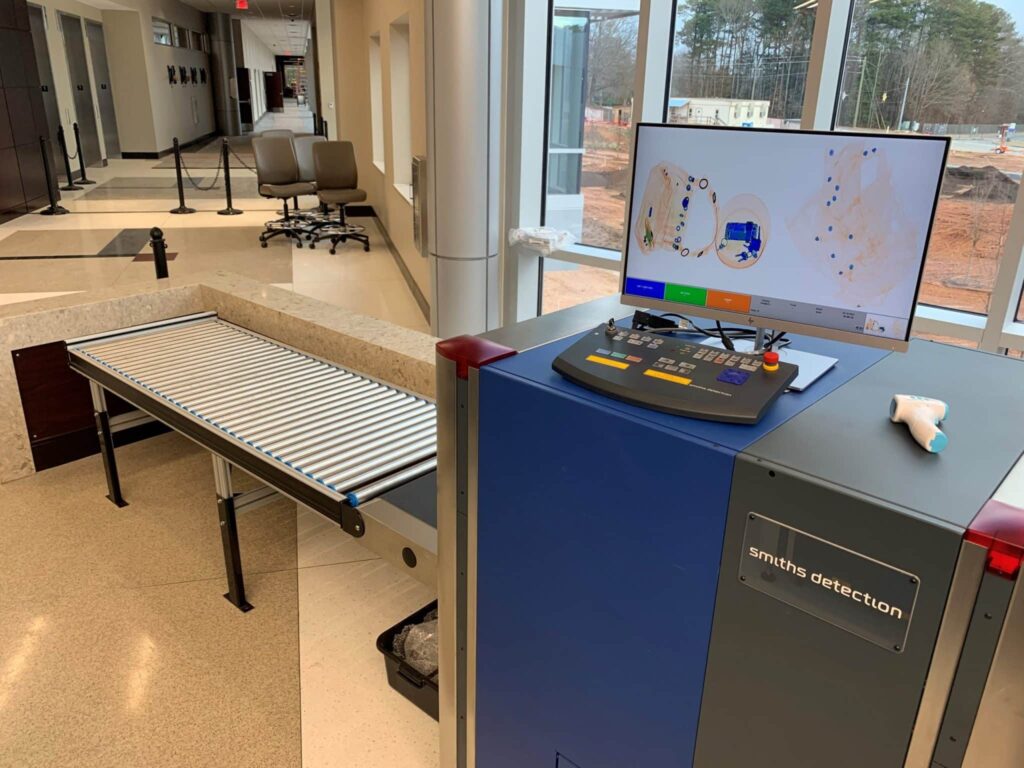
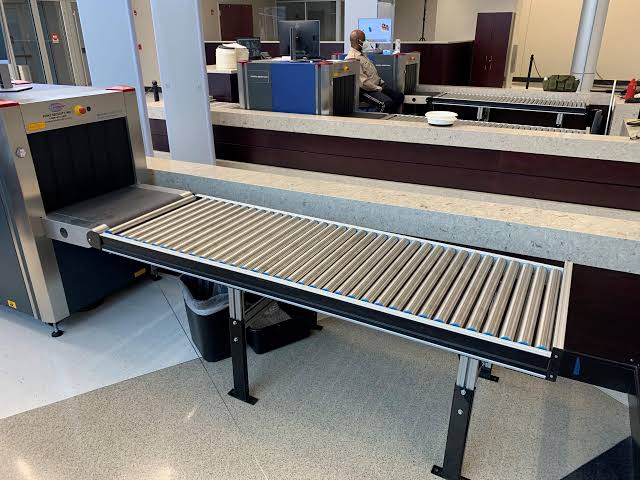
3.2 Element two: Smiths Detection X-ray — bag screening
Point Security specifies one of two Smiths Detection X-ray inspection systems for the bag screening element, depending on campus scale, budget, and mobility requirements.
HI-SCAN 5030C
The HI-SCAN 5030C is Smiths Detection’s most compact X-ray inspection system, built on the HiTraX 3 electronics and software platform. It is designed for screening bags, parcels, and personal items in confined checkpoint spaces, and Smiths identifies schools explicitly among its intended applications alongside courthouses, correctional facilities, and event venues. [18]
For K-12 deployment, its defining feature is transport-hardened mobility. The 5030C is available as a stationary desktop unit or as a mobile version on wheels with vibration shock absorbers and an integrated storage compartment. The vibration absorbers allow the system to be moved between locations without requiring recalibration, and its footprint and weight allow it to pass through standard doorways. [18] For a district that wants a single X-ray asset that follows the OPENGATE from the front entrance to the gymnasium to the auditorium, this is the enabling design choice.
SDX 6040
The SDX 6040, introduced by Smiths Detection in September 2024, is the higher-performance option. It is built around a 160 kV generator and is positioned by the manufacturer for environments requiring both high image quality and mobility. Its smart image display includes organic stripping and enhancement modes that provide discrimination between organic and inorganic materials — the capability directly relevant to detecting explosives, narcotics, and non-metallic threats that no electromagnetic system will find. [19]
Its mobility case is built on a narrow 80 cm footprint and larger casters, allowing relocation across sites, and an optimized background contrast function intended to reduce operator eye strain during extended screening periods. [19] The last point is not cosmetic. Morning arrival screening asks an operator to interpret several hundred X-ray images inside a thirty-minute window, day after day. Vigilance decay is a real and studied failure mode in screening operations, and design features that extend sustainable operator attention are detection features.
The SDX 6040 also integrates with Smiths Detection’s iCMORE Prohibited Items automatic target recognition, which provides automated detection of pistols, revolvers, gun parts, flick and fixed blade knives, grenades, blasting caps, ammunition, and blunt objects. [19]
3.3 A note on automation philosophy
Both major approaches to bag screening in this market use algorithms. The meaningful difference is what the algorithm is for.
One approach positions autonomous interpretation as the product: the system scans bags and identifies threats without a staff member monitoring a screen, and without staff requiring specific training to interpret an X-ray image. Presented as a labor and training advantage, this is a real and legitimate benefit for many operators. [25]
The architecture Point Security specifies makes the opposite choice deliberately. Automatic target recognition is available on the Smiths platforms and we configure it where districts want it — but it operates as an aid to a trained operator viewing the image, not as a replacement for one. The reason is straightforward: an automated system finds what it was trained to find. A trained operator looking at a material-discriminated image can recognize that something is wrong even when the object does not match a known signature — an unfamiliar shape, an implausible density, a modified item, a component rather than an assembled weapon.
This is a genuine trade-off rather than a defect in either design. Autonomous interpretation reduces staffing cost and training burden, which are real constraints for districts. Operator-in-the-loop screening costs more and demands more, and detects a broader category of things. We think K-12 districts should make that choice knowingly, and we are candid with prospective clients that our architecture is the more demanding one to staff.
An algorithm finds what it was trained on. A trained screener can notice that something is simply wrong. In an environment where the threat is more often an ordinary object misused than a recognizable weapon, that difference is the entire margin.
4. Standards: How to Verify Rather Than Trust
The most useful thing a district can do in this procurement is stop evaluating vendor claims and start evaluating vendor claims against published standards. The framework exists, it is public, and it was built for exactly this purpose.
4.1 ASTM F3566-22
ASTM F3566-22, Standard Performance Specifications and Test Methods for Walk-Through Metal Detectors Used in Safety and Security, was published in November 2022 under ASTM Committee F12. It applies to all walk-through metal detectors used to find metal contraband concealed on people, and it establishes baseline acceptable technical performance requirements across metal object detection performance, electrical and mechanical safety, fire safety, electromagnetic compatibility, environmental operating ranges, and mechanical durability. [1]
Two features of F3566-22 make it particularly valuable to a school district. First, it prescribes test methods, not merely requirements — it specifies how detection performance is to be measured, including the design of the threat object exemplars used in testing, so that results are comparable across manufacturers. [1] Second, it explicitly invites the adopting agency to layer its own operationally-derived requirements on top of the baseline. [1] A district is not merely permitted to add school-specific requirements to an F3566 specification; the standard anticipates it.
The U.S. Department of Homeland Security Science and Technology Directorate has identified F3566-22 as the mechanism that allows manufacturers to submit their systems for independent third-party evaluation. [3] That is the point of the standard: it converts a marketing claim into a testable proposition.
4.2 NIJ Standard-0601.02
NIJ Standard-0601.02, Walk-Through Metal Detectors for Use in Concealed Weapon and Contraband Detection, was published by the National Institute of Justice in January 2003 and prepared by the National Institute of Standards and Technology. It establishes performance requirements and test methods for active walk-through metal detectors used to find metal weapons or contraband carried on a person or concealed by a non-metal object. [2]
Its acceptance requirements span electrical performance, detection performance, operating requirements, mechanical specifications, functional requirements, detector mounting, quality control, and documentation. Detection performance specifications include sensitivity, speed, repeatability, discrimination, operating controls, and environmental ranges. Its test procedures cover detection performance, alarm indication, operation adjacent to a metal wall or steel-reinforced floor or moving metal door, and burn-in. [2]
The lineage matters for anyone reading specifications in this market. The original standard was NILECJ-STD-0601.00, issued in 1974 and structured around five security levels of increasing detection strictness. NIJ revised it as 0601.01 in 2000 and again as 0601.02 in 2003, the 2003 revision adding material specifications through the Unified Numbering System classification scheme. [2][17][23] Documents citing the 1974 NILECJ designation are citing a standard that has been superseded twice. The current reference for a district specification is NIJ Standard-0601.02.
The five-security-level structure inherited from the original NILECJ standard is the most useful concept in this entire framework for a school board. It converts “how sensitive should our detectors be” from a technical question into a policy question the board can actually deliberate, document, and defend.
4.3 DHS SAFETY Act status — and how to read it
The Support Anti-Terrorism by Fostering Effective Technologies Act of 2002 is the most frequently cited credential in this market and the most frequently misread. It has distinct tiers conferring materially different protections, and vendors at different tiers describe themselves using very similar language. [6]
|
Tier |
What DHS has concluded |
Liability protection conferred |
|
Developmental Testing & Evaluation Designation |
Technology shows potential but has limited or no operational history. Term generally not to exceed 36 months; terminable at will by DHS |
Designation-level protections, limited to the DT&E period and subject to deployment constraints |
|
Designation |
Technology has demonstrated effectiveness with repeatable results in operational use |
Liability capped at the insurance level DHS sets; no joint and several liability for non-economic damages; immunity from punitive damages |
|
Certification |
DHS has high confidence the technology will perform as intended and conforms to the seller’s specifications. Designation is a prerequisite. Placed on the DHS Approved Products List |
All Designation protections plus the ability to assert the Government Contractor Defense, which if successfully asserted eliminates seller liability for covered claims |
Applied to the products discussed in this document: CEIA USA holds SAFETY Act Designation for the OPENGATE, awarded in 2023 with a term running through June 30, 2028. Separately, CEIA USA holds SAFETY Act Certification — the higher tier — for its long-standing series of walk-through and hand-held metal detectors, renewed in May 2023 with a term running through May 31, 2028. CEIA solutions have held SAFETY Act awards continuously since 2006. [5]
For completeness and fairness: the principal AI-based competitor in this market also holds SAFETY Act Designation as a Qualified Anti-Terrorism Technology for its walk-through product, awarded in 2022. [26] Both products hold Designation. Only one manufacturer in this comparison holds Certification for any product line, and Certification is the tier that carries the Government Contractor Defense. [6] Districts should ask which tier applies to the specific model they are purchasing, and through what date — the credential attaches to a product and a term, not to a company in perpetuity.
4.4 Two standards districts routinely omit
Two additional ASTM standards belong in any K-12 screening specification and are almost never included:
5. The Campus Reality: Where Screening Has to Happen
A K-12 campus is not a building, and this is where portability stops being a convenience and becomes a detection requirement.
The building-centric security model — secure the entrance, screen who enters, control the interior — works reasonably well for airports, courthouses, and correctional facilities, where access is funneled through a small number of fixed points. A typical K-12 campus has a primary entrance, multiple secondary doors, a gymnasium with independent exterior access, athletic facilities distributed across outdoor grounds, and a cafeteria or auditorium that doubles as a public event venue. The physical footprint of risk changes across the school day and across the academic calendar.
A fixed system at the primary entrance addresses one screening moment. It provides no coverage at the evening basketball game, the Friday night football game, the outdoor graduation ceremony, the school board meeting, the theater performance, or the weekend tournament hosted across three venues simultaneously. Each of these is a distinct security moment, frequently at a different location than the main entrance, frequently outside school hours, and frequently drawing a mixed population of students, families, alumni, and community members who have not been screened before.
This is the operational case for a system that can be carried by one person and stood up in under a minute. It is not a budget concession. It is the only architecture under which a district’s stated screening standard applies uniformly to every occasion on which its community assembles.
5.1 Deployment scenarios
|
Scenario |
Configuration |
Notes |
|
Morning arrival, primary entry |
1-2 OPENGATE units plus one X-ray system; 2-4 officers |
Highest-volume moment. Baseline throughput data collected here informs all later deployment decisions |
|
Morning arrival, high-volume campus |
2+ OPENGATE units in parallel lanes plus X-ray; 3-4 officers |
Parallel lanes are the correct response to queue pressure — not reduced sensitivity |
|
Indoor athletic events |
1-2 units staged at gymnasium exterior entrance |
Separate from main school entry; units return to secure storage after the event |
|
Outdoor athletic events |
Units at stadium gates or field access points; battery operation |
No electrical infrastructure or overhead cover required at the gate |
|
Dances, prom, ceremonies |
Scale to expected attendance and entry point count |
Mixed student and outside-guest population; screening standard should match or exceed daily program |
|
Graduation |
Units travel to the ceremony venue, on or off campus |
Maintains a consistent screening standard regardless of where the ceremony is held |
|
Overflow and burst capacity |
Supplemental lane deployed alongside primary screening |
First day of school, testing days, atypical arrival patterns |
The overflow case deserves particular emphasis because it is the scenario in which detection standards most often quietly erode. When a queue builds beyond what the checkpoint can process, the operational pressure is to reduce sensitivity, wave people through, or suspend screening entirely. A portable architecture answers queue pressure by adding a lane rather than by lowering the standard — which means the district’s documented detection policy survives contact with a bad morning.
6. Comparative Framework
The table below compares screening architectures rather than specific competing products, because the architectural choice is the one that determines what a program will and will not find. Districts should populate the specific-product columns themselves using vendor responses to the evaluation questions in Section 9.
|
Capability |
OPENGATE + Smiths X-ray |
Walk-through only |
Fixed WTMD + X-ray |
Wand only |
|
Screens people for metallic threats |
Yes |
Yes |
Yes |
Yes |
|
Images bag contents |
Yes |
No |
Yes |
No |
|
Detects non-metallic threats in bags |
Yes |
No |
Yes |
No |
|
Organic / inorganic material discrimination |
Yes |
No |
Varies |
No |
|
Relocatable by one person |
Partial |
Yes |
No |
Yes |
|
Rated for outdoor operation |
Yes |
Varies |
No |
Yes |
|
Operates on battery without mains power |
Partial |
Yes |
No |
Yes |
|
Built to ASTM F3566-22 security levels |
Yes |
Varies |
Varies |
N/A |
|
Multi-zone threat localization |
Yes |
Varies |
Yes |
N/A |
|
Suitable for compressed arrival window |
Yes |
Yes |
Yes |
No |
|
Setup under one minute |
Partial |
Yes |
No |
Yes |
“Partial” in the combined architecture column reflects an honest limitation: the OPENGATE relocates in under a minute by one person, while the X-ray element — even in its mobile, shock-absorbed configuration — requires a cart, a doorway-width path, and generally two people. A district running a full layered checkpoint at an outdoor athletic gate should plan for that. Where an event genuinely cannot accommodate the X-ray element, the honest description is that the event is running people screening only, and the district should record that as a deliberate decision rather than let it pass unremarked.
Wand-only programs appear in this table because they remain common and are frequently proposed as a budget alternative. They are a legitimate secondary screening tool — Point Security stocks and services the CEIA PD140 and PD240 for exactly this purpose — but they cannot function as a primary screening method at K-12 arrival volumes. A wand requires individual engagement with every person screened, which makes the arrival window arithmetic impossible at any school of meaningful size.
7. Implementation
7.1 Phased deployment
Point Security recommends that districts new to walk-through screening implement in phases. A phased approach lets administrators, staff, and students adapt to screening culture progressively, and gives the security team the operational experience to optimize deployment before expanding scope.
Phase 1 — Primary entry, single campus
Deploy one or two OPENGATE units plus one X-ray system at the main entrance of a single school. Establish the detection standard in writing before the first day of operation, including the sensitivity configuration and the secondary screening procedure. Use the first semester to baseline throughput, alarm rate, and staffing load. Resist the temptation to adjust sensitivity in response to queue pressure during this period — the baseline is only useful if it reflects the standard the district actually intends to hold.
Phase 2 — Event coverage
Extend the program to athletic events and after-hours activities using the same units. Develop venue-specific deployment plans and establish storage, transport, and charging protocols. This phase is where the portability investment returns value, and where the district discovers whether its event screening standard matches its daily standard.
Phase 3 — District scale
Determine additional unit requirements for simultaneous multi-point coverage based on Phase 1 and Phase 2 data. Develop deployment matrices matching unit positioning to event type and campus location. Formalize a documented screening standard covering all school and community events held on district property.
7.2 Staffing
Equipment performance depends on operator capability, and understaffing is the most common way a well-specified program degrades into a checkbox program. Recommended minimums:
|
Scenario |
Minimum staffing |
|
Morning arrival, single lane, people screening only |
2 officers — one monitoring the OPENGATE, one conducting secondary screening |
|
Morning arrival, single lane, with X-ray bag screening |
3 officers — one at the OPENGATE, one at the X-ray console, one on secondary |
|
Morning arrival, dual lane with X-ray |
4-5 officers — one per walk-through lane, one at the X-ray console, one or two dedicated to secondary |
|
Outdoor athletic events |
2 officers per OPENGATE deployed, plus one roving secondary screener |
|
Special events and ceremonies |
Scale to expected attendance and number of entry points |
The X-ray console position is not interchangeable with the walk-through position. Image interpretation is a distinct skill requiring dedicated training and periodic recertification, and it degrades measurably with fatigue. Districts should plan for operator rotation during extended screening periods rather than assigning a single staff member to the console for the full arrival window.
7.3 Training
Point Security provides hands-on training for all deployments, covering:
The last item is the one most often omitted and the one that matters most over time. A screening program that is never tested against its own stated standard will drift. Regular documented testing — using appropriate test objects at the district’s selected security level — is what allows a superintendent to state with confidence, at a board meeting or in a deposition, what the program was configured to find and that it was verified to find it. [26]
7.4 Policy and communication
The most technically capable screening system will underperform if students, families, and staff do not understand or support the program. Point Security recommends districts invest as much in policy development and community communication as in equipment selection. Core policy elements:
A note on the relationship between screening and prevention: the U.S. Secret Service National Threat Assessment Center, examining 67 disrupted plots against K-12 schools between 2006 and 2018, found that every one of them was averted because a bystander — most often another student — observed concerning behavior and reported it to someone who could act. NTAC’s consistent recommendation is that schools implement multidisciplinary behavioral threat assessment programs. [22][23]
Entry screening does not substitute for that work, and Point Security does not present it as though it does. Screening addresses the threat that has already arrived at the door. Behavioral threat assessment addresses the threat before it forms. A district investing in one and not the other has covered half the problem, and we would rather say so plainly than sell equipment against a gap we know exists.
8. Frequently Asked Questions
Do K-12 schools need walk-through screening?
That is a policy decision each district must make based on its threat environment, community values, and administrative capacity, and reasonable districts reach different conclusions. What is not optional, once a district decides to screen, is specifying what the program is meant to find and verifying that the equipment does it. A program that generates excessive nuisance alarms, cannot process the arrival volume, or covers only one of a campus’s many entry moments will not deliver the security value that justifies its cost — and will erode community support in the process.
What does this cost?
Total program cost has four components, and equipment is usually not the largest over a five-year horizon. Those components are equipment acquisition or rental, installation and any facility modification, recurring staffing, and training with periodic recertification. Portable systems eliminate most of the second category — the OPENGATE requires no structural installation or electrical work, and the mobile X-ray configurations require no permanent siting. Staffing is typically the dominant recurring cost, which is why the staffing table in Section 7.2 should be part of the budget conversation from the beginning rather than discovered afterward. Point Security provides detailed five-year cost modeling for prospective district clients, including purchase versus rental comparison.
Can we start with a rental?
Yes, and for districts implementing a first screening program we often recommend it. A rental period lets administrators validate throughput against their actual arrival volume, assess real staffing requirements, and build community support before committing to acquisition. Rental units are maintained to the same performance standard as purchased equipment. This also allows a district to test its detection standard in practice before the standard is embedded in a capital purchase.
What is the difference between a walk-through system and a handheld wand?
Walk-through systems provide primary screening — every individual passes through as part of normal traffic flow, which enables high throughput without individual engagement. Handheld wands such as the CEIA PD140 and PD240 are secondary screening tools used to localize the source of an alarm the primary system has already raised. A complete program requires both. Wand-only programs cannot achieve the throughput needed for a K-12 arrival window because they require individual engagement with every person screened.
Can a portable system perform as well as a fixed system?
Portability and detection performance are independent design variables. The relevant question is not whether a system is portable but whether it is built and tested to a published performance standard, and at what security level it is configured. Ask any vendor — portable or fixed — to state which standard their system is built to, at what level it is configured for your deployment, and how that configuration will be verified after installation. A vendor who can answer those three questions specifically is a vendor whose claims you can check.
How do walk-through metal detectors work?
They generate a low-frequency electromagnetic field within the detection zone. A conductive object passing through the field disturbs it, and the system’s electronics detect and characterize that disturbance. Advanced systems use multi-zone detection to identify the approximate location of the object on the body, enabling targeted secondary screening rather than a full pat-down. Discrimination algorithms distinguish threat signatures from common benign items to reduce nuisance alarms. The essential limitation, common to all such systems regardless of how the signal is processed, is that they detect conductive objects — which is the reason for the X-ray element in a layered architecture.
What certification standards should we specify?
For K-12 applications Point Security recommends specifying ASTM F3566-22 and NIJ Standard-0601.02 for walk-through equipment, with the security level stated explicitly. Add ASTM F2401-24 for medical device accommodation procedure and ASTM C1238-24 for installation siting. Ask for DHS SAFETY Act status by tier, by specific model, and with the expiration date. Referencing published standards in a bid specification gives a district independent, third-party validation it can cite in board presentations, grant applications, and procurement documentation — and it gives the district a basis to compare vendors on something other than their own marketing.
Can the same equipment be used at athletic events?
This is one of the strongest arguments for the portable architecture. The same OPENGATE units that screen students at morning arrival can be relocated to the gymnasium entrance for an evening basketball game or carried to the stadium gate for Friday night football, and the mobile X-ray configuration can follow for events where bag screening is warranted. This means the equipment investment serves the district’s full event calendar rather than a single daily window — and, more importantly, it means the district’s screening standard applies to every occasion on which its community gathers rather than only to the ones with a permanent checkpoint.
Our neighboring district uses a different system and is happy with it. Why change?
Peer satisfaction is meaningful data and we do not dismiss it. But satisfaction with a screening program and validated detection performance are different measurements, and the first is much easier to observe than the second. A program that runs smoothly, generates few complaints, and moves students quickly will generate high satisfaction whether or not it is finding things. We would encourage any district evaluating a peer’s program to ask that peer three specific questions: what security level is your system configured to, how often do you test it against that standard, and what has it found. Those answers are more informative than a general endorsement — and if the peer district’s answers are strong, that is genuinely useful evidence in that vendor’s favor.
9. Evaluation Questions for Any Vendor
The following questions are the ones we believe determine whether a screening program will find things. We recommend districts put them, in writing, to every vendor under consideration — including Point Security. A vendor who answers them specifically has given you something you can verify. A vendor who answers them in terms of throughput, deployment count, or customer logos has told you something about their marketing rather than their equipment.
On detection
On bags
On credentials
On operations
We publish these questions knowing they will sometimes be used against us. That is the point. A district that can evaluate rigorously is a district that can defend its decision — and a specialist dealer would rather compete on answers than on adjectives.
10. Working With Point Security
Point Security, Inc. is a certified small business headquartered in Lexington, North Carolina, and an authorized dealer and factory-trained service provider for CEIA USA and Smiths Detection. Our team’s experience in security screening spans more than three decades across government, corrections, courthouse, education, and transportation environments.
No-cost campus assessment
Every school engagement begins with a no-cost campus assessment. We evaluate entry points, event venues, staffing capacity, facility construction — including the steel and reinforced-concrete conditions that affect detection performance — and program goals, and we develop a deployment recommendation matched to how your campus actually operates. We do not quote from a generic template.
Purchase and rental
We offer both purchase and rental for the CEIA OPENGATE and Smiths Detection X-ray systems. Districts evaluating a first screening program frequently benefit from beginning with a rental, which allows validation of throughput, staffing, and detection standard before capital commitment.
Training and screener development
We provide comprehensive hands-on training covering system operation, alarm protocol, X-ray image interpretation, secondary screening procedure, and event-specific deployment configuration — and we support school resource officers and campus administrators with ongoing training resources as staff change and programs evolve.
Local service
Our factory-certified technicians are local. When equipment needs attention, response comes from North Carolina rather than from a national dispatch queue. For a program where equipment availability is a student safety matter rather than a convenience matter, service proximity is a specification, not a courtesy.
Complete secondary screening
We stock and service the CEIA PD140 and PD240 handheld detectors — the same secondary screening instruments specified for courthouse and corrections environments — and we train primary and secondary screening as one integrated procedure rather than as separate equipment operations.
Conclusion
The case for the architecture described in this document is not a portability argument, and it is not a throughput argument. Both of those are real advantages and neither is the point.
The point is that a K-12 screening program should be built backward from a written answer to the question of what it is meant to find. That answer determines the security level. The security level determines the alarm rate. The alarm rate determines the staffing. And the staffing determines whether the program that exists in the operations manual is the program that exists at the door on a rainy Tuesday in February when two officers called out and the line is backing into the parking lot.
The CEIA OPENGATE paired with a Smiths Detection HI-SCAN 5030C or SDX 6040 covers the K-12 threat profile — people and bags, metallic and non-metallic, at the front entrance and at the stadium gate — at throughput rates compatible with a compressed arrival window, built to standards a district can cite and verify. Portability is what allows that standard to follow the community to wherever it gathers, rather than applying only where a checkpoint was poured in concrete.
A screening program is a promise a district makes to its families. It should be a promise the district can describe precisely, verify independently, and defend on its worst day.
Specify what you intend to find. Verify that it does. Everything else is a consequence.
References
Sources are listed in order of first citation. Manufacturer specifications should be verified against current published documentation at the time of procurement, as products and certifications are subject to revision.
Contact Point Security, Inc.
To request a no-cost campus assessment, arrange an OPENGATE or X-ray demonstration, or discuss rental and purchase options for your district:
Web: www.pointsecurityinc.com
Location: Lexington, North Carolina
Point Security, Inc. | Certified Small Business | Authorized Dealer: CEIA USA · Smiths Detection
CEIA, OPENGATE, SAMD, PD140, and PD240 are trademarks of CEIA S.p.A. or CEIA USA, Ltd. HI-SCAN, SDX, HiTraX, HI-MAT, and iCMORE are trademarks of Smiths Detection Group Ltd. Evolv, Evolv Express, and Evolv eXpedite are trademarks of Evolv Technologies, Inc. All third-party marks are the property of their respective owners and are used here for identification and comparative reference only.